Place Massena is the vibrant main square of Nice, France, bridging the city’s Old Town and its newer districts. Ringed by arcaded buildings packed with shops and restaurants, the plaza sits at the intersection of several grand boulevards, making it a favorite gathering spot for both residents and visitors. A modern tram glides through the center, while the rest of the square remains delightfully pedestrian-friendly.
A Square Painted in Color
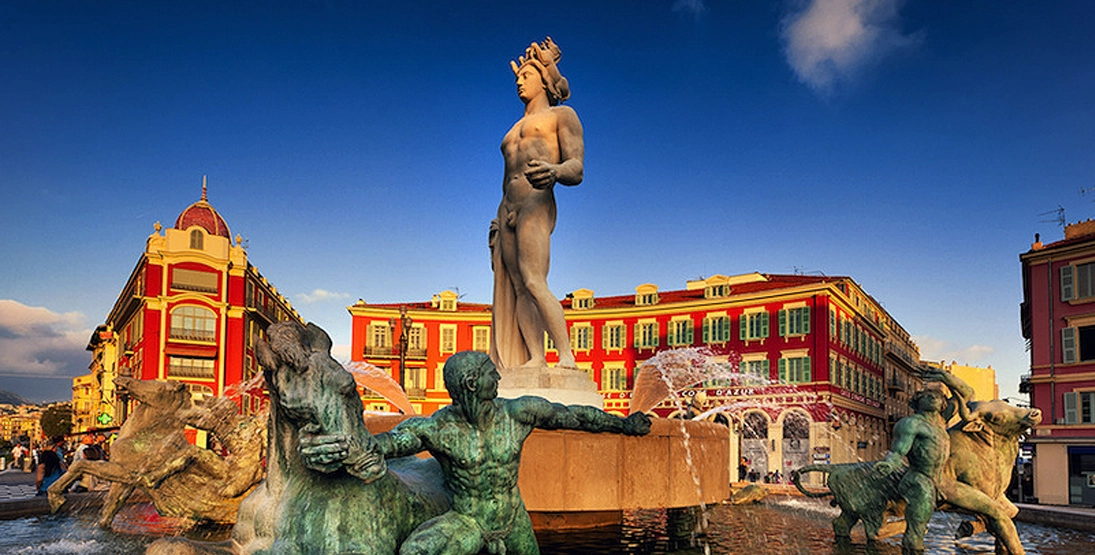
What strikes me first is the color: facades in bold reds, warm yellows, and sunlit oranges, punctuated by bright blue shutters that pop against Nice’s brilliant spring sky. The palette feels almost theatrical—cheerful, confident, and unmistakably Mediterranean.
A Name Steeped in History
Place Massena takes its name from André Masséna, a celebrated French military commander of the Revolutionary and Napoleonic eras. One of Napoleon’s eighteen Marshals of the Empire, he earned the nickname l’Enfant chéri de la Victoire—“the Dear Child of Victory”—a fitting honorific for the square that beats like the city’s heart.
Seven Figures, Seven Continents
Scattered across the square are seven slender, seated figures designed by Spanish artist Jaume Plensa. They symbolize the world’s continents and, more poetically, the ongoing conversation among today’s diverse communities. After dusk, the figures glow in shifting colors, transforming the plaza into a quietly luminous stage.
La Fontaine du Soleil
At the south end of the square, the Sun Fountain commands attention. At its center rises a seven-meter statue of Apollo—crowned, nude, and gripping a draped cloth—surrounded by five mythological figures representing Mercury, Venus, Earth, Mars, and Saturn. With its classical lines and constant splash of water, the fountain doubles as a beloved photo spot and a breezy place to linger.
Controversy and Comeback
Alfred Janniot’s monumental Apollo hasn’t always had a smooth reign. Over the years the statue drew criticism—especially for its nudity—and at one point was even moved to a football stadium after protests by local groups. Its absence left a conspicuous void in the fountain’s composition. Eventually, Apollo returned to his rightful place, where he presides once more over Place Massena’s radiant centerpiece.
Visiting Tips
-
Come at golden hour for the most flattering light on the colorful facades.
-
Stay after sunset to see Plensa’s figures glow in rotating hues.
-
Pair a stroll through the square with a detour to the nearby Promenade du Paillon and the Old Town.
-
If you’re photographing, a wide-angle lens helps capture the tram lines, fountain, and painted buildings in a single frame.